
The Load That Talks Back
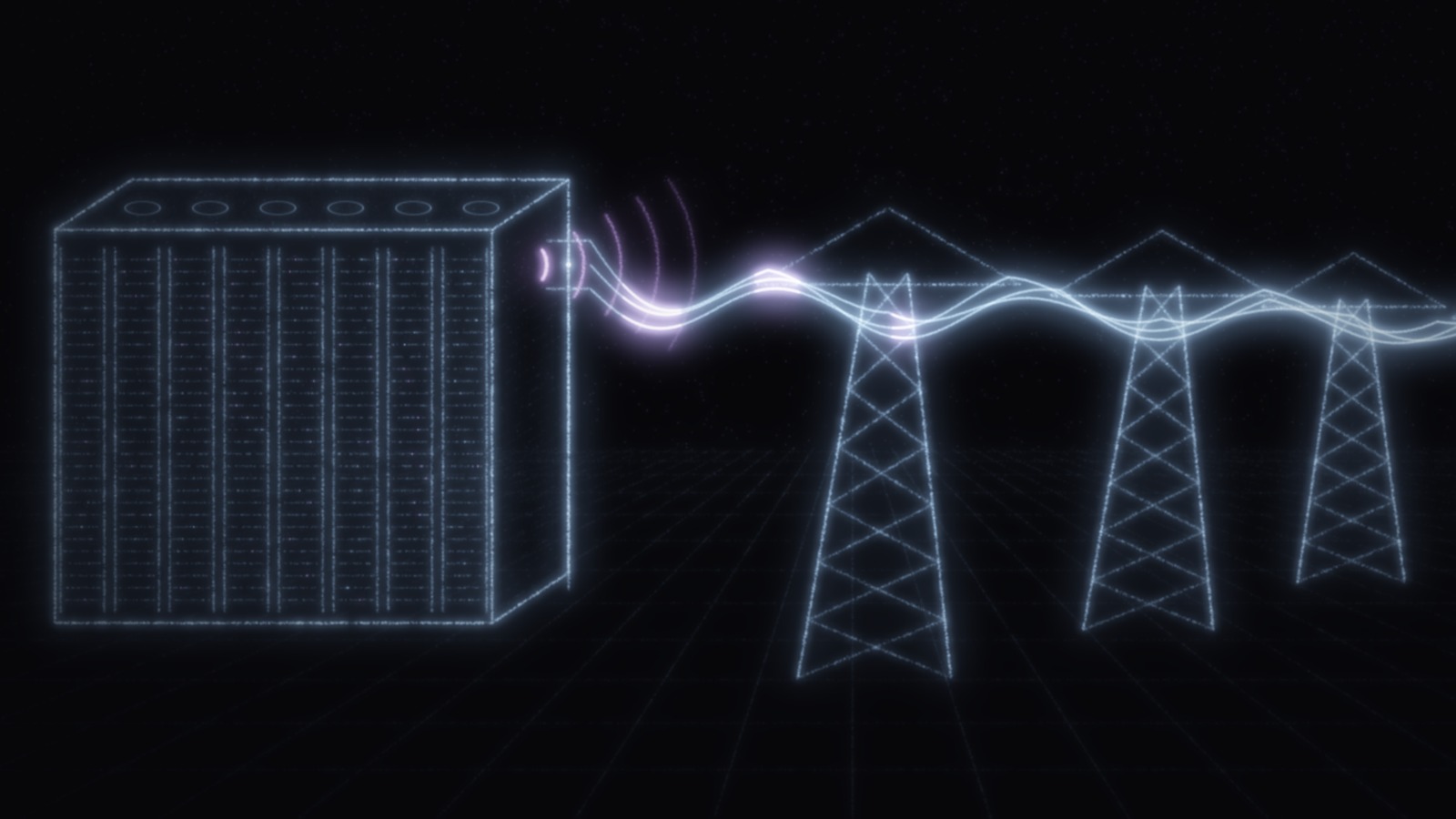
On 22 July a transmission fault in the PJM system, the kind protection equipment clears routinely, did something the grid had never seen at that scale. Data centres across the Northern Virginia corridor sensed the voltage dip and moved themselves onto their own backup supply. About 2,970 megawatts left the grid in a first stage and another 1,099 followed roughly a minute later: a two-stage transfer of about 4.1 gigawatts gross, around 3.9 gigawatts net on one reconstruction. Generators that had been matched to that demand were suddenly feeding a hole, and frequency across the Eastern Interconnection jumped. Inside the buildings, the protected load stayed powered. That is the whole problem, stated in one event.
Architecting Alpha, Part XI
The Next Petrodollar argued that the next order is being built on electricity priced in compute, and that capital is moving to where the electrons are because electrons cannot move to capital. The Grid Becomes Venture-Shaped argued that of the three ways to answer the new load, venture capital can live in two, because utilities are paid to pour concrete rather than write software. Both essays treated the data centre as a demand problem: a very large, very hungry, essentially passive customer.
That framing is now incomplete, and a review posted to arXiv on 6 October explains why with unusual precision. AI Data Centers Meet Electrical Grids, by Mariam Mughees, Yuzhuo Li, Yize Chen and Yunwei Ryan Li of the University of Alberta, is a preprint and not yet peer reviewed. It follows the electrical path from the accelerator die to the point where the campus meets the transmission system. Its finding is that the large data centre has stopped being a passive load. It responds to the grid on its own, through protection and control logic the grid does not see, and AI is adding a second layer of behaviour on top: software that decides when thousands of processors draw power together.
This essay is about what that does to the economics of the electron layer, and who gets paid when it is fixed.
The claim, and how it fails
The AI power problem has been priced mainly as a shortage of supply. An equally binding constraint is integration: the time, risk and control between an electron existing and an electron being delivered to a load that behaves. Large data centres are already power-electronic machines whose protection logic reaches the grid, and AI training and agent workloads add programmable timing on top. Integration therefore fails in three places at once: on paper, in physics, and in observability. My conjecture is that over the next decade more of the marginal value accrues to whoever makes large load observable, controllable and verifiable at the point of interconnection than to whoever produces the marginal electron. And the terms of the connection itself, firm or flexible, are becoming a priced variable.
Five ways this is wrong. It may simply be a supply shortage after all, and integration a second-order story. Utilities may build enough and force every large load onto firm connections, so controllability never earns a price. The events so far may be teething problems a single standard fixes, leaving no rent for anyone. Efficiency may shrink demand faster than it grows. And the largest campuses may leave the grid entirely. I take all five at the end.
Part I. Load that leaves
The July event was not the first. It was the largest.
On 10 July 2024 a fault on a 230 kilovolt line in the same corridor was followed by about 1.5 gigawatts of data centre load transferring to behind-the-meter backup, spread across roughly 25 to 30 substations and 60 load points. In Texas, ERCOT identified 26 events between January 2023 and September 2025 in which large electronic loads at cryptocurrency facilities each dropped more than 100 megawatts during routine voltage disturbances, shedding between 17 and 95 percent of what they had been drawing. The review assembles these into a table of incidents from 2022 to 2026. The two largest data centre events came two years apart in the same corridor, and the second was more than twice the size of the first.
The mechanism is mundane, which is what makes it dangerous. A data centre's uninterruptible power supply is designed to protect the computers inside, not the grid outside. When voltage sags past a threshold, the UPS does exactly what it was built to do: it stops drawing from the grid and carries the servers on stored energy. From inside, a perfect ride-through. From outside, a step disconnection of hundreds of megawatts. Multiply that by every campus on the same corridor, all sensing the same dip and running similar protection logic, and a fault the grid would have absorbed becomes a contingency the grid has to survive.
The review's authors simulate the effect on a deliberately small test system of 30 gigavolt-amperes, which is not calibrated to the Virginia events. In that setting, a nominal two-gigawatt campus transferring to battery pulls grid import down by almost two gigawatts, and frequency starts rising at close to half a hertz per second; the larger the transfer and the lower the system's spinning mass, the steeper the climb. In the real 22 July event, frequency across the Eastern Interconnection peaked at roughly 60.092 hertz, against 60.047 in the 2024 event. Operators and transmission protection held it. Nobody should mistake holding it for designing for it.
The deeper point is one this series has made before about finance, now made about physics. Correlation is the risk, not size. One data centre tripping is an incident. Fifty data centres running the same protection logic on the same corridor behave like a single machine with a single trigger, and nobody owns it.
One honest caveat before going further. None of the documented events above has been traced to AI workloads specifically. They are protection and control behaviour, much of it in facilities serving ordinary cloud and enterprise demand. The AI-specific risk is the review's projection of what comes next, and it is the subject of the next part.
Part II. Load that sings
The second failure is subtler and, in the long run, more expensive.
Dominion Energy has documented a recurring oscillation of about 14.7 hertz in its 115 kilovolt Northern Virginia data centre corridor, observed across 2022 and 2023. One episode began overnight with visible voltage flicker at three nearby substations, shortly after the routine ramp-down of four hydro units at a station that supplies fault current to the area, and persisted for nearly two hours across the wide-area measurement network. It was traced to a single campus among several on the same substations. Investigators judged the frequency too low for a plausible mechanical or network resonance and consistent with the control loop of a UPS or active rectifier. The review's reading is that the campus appears to have been creating a new oscillation through its own interaction with a weakened corridor, rather than exciting an existing weakness in the network.
Here is why that can happen. A modern data centre campus is thousands of power converters regulating their internal voltage tightly. In aggregate, that behaves like a constant-power load: when grid voltage falls, it draws more current to hold its power steady, which pulls voltage down further. On a strong grid, with plenty of large spinning generators supplying fault current, the effect is small. On a weak grid it erodes damping. In the authors' one-gigawatt simulation, cutting the grid's short-circuit strength from six to two gigavolt-amperes cut the damping ratio of the key voltage mode by roughly a third and pulled its frequency down from about 38 to about 27 hertz. Every case within operating limits stayed stable; weaker cases fell outside those limits and were excluded. The margin shrank anyway.
Now add the AI workload. Large training runs are synchronised: thousands of accelerators compute, then pause together to exchange results, then resume. Those communication cycles take tens of milliseconds, which puts the fundamental frequency of the resulting power swing between about 20 and 40 hertz, the band where a weak, converter-heavy grid is least damped. Slower rhythms, from batch boundaries, power caps and the chillers that follow the compute, and possibly checkpoints, fall between 0.1 and 1 hertz, the band towards which oscillations between distant generator groups are migrating as coal and gas plants retire. NERC's Level 3 alert of May 2026, its highest category, named AI training alongside electric arc furnaces as the loads most likely to force oscillations into the bulk power system.
Sit with that pairing. The most advanced computing workload on earth now shares a reliability category with a steel furnace.
It lands hardest where the grid is already weakest. Displace synchronous generation with inverters and you reduce both inertia and fault current, which is the direction most decarbonising systems are travelling. Weakness is also situational: the Dominion episode began when the hydro units supplying the corridor's fault current ramped down for the night. And it is structural in places where renewable resources sit at the end of long, thin lines. In South Africa's Cape provinces, for instance, an industry body citing Eskom's own assessment reports the capacity to connect new generation depleted, evidence of how thin the transmission network is in exactly the places the resource is richest. The review puts the corollary carefully: a region rich in energy may still offer little firm, dynamically stable headroom at the specific substation where you want to build. Abundant electrons and connectable electrons are different assets.
Part III. Efficiency will not save you
The most popular rebuttal to every AI energy argument is efficiency. Models are getting smaller, chips are getting better, energy per token is falling fast, so the problem shrinks. The review takes this apart with one distinction that deserves to become standard: falling energy per token need not lower peak demand, grid disturbances or emissions.
Three reasons. First, efficiency lowers the average, while the failures above are about the swing: the ramp, the step, the correlated pause. When synchronisation and checkpoint phases idle large parts of a training fleet, facility power can fall towards its idle floor of 20 to 25 percent within seconds and recover just as quickly, however efficient each chip is. Second, a site that is power-constrained may not bank its efficiency gains at all; it may spend them, running more tokens through the same megawatts. I argued in Everything Converts that commensuration relocates the premium rather than abolishing it. Efficiency does something similar to the power problem: it moves the constraint from energy towards coherence. Third, density keeps rising, so more load sits behind each rack and each campus. The review cites NVIDIA's Vera Rubin NVL72 at between 190 and 230 kilowatts per rack.
There is a quieter version of the same error in measurement. Standard GPU telemetry samples far more slowly than the sub-millisecond transients that stress the hardware. Throttling, power capping and qualification testing all act on filtered statistics, so the worst events are the ones nobody records. You cannot price what you cannot see, and the industry is mostly pricing averages.
Part IV. The source of the swing is software
The review's organising idea is what it calls bandwidth matching, and it is the most useful frame for anyone allocating capital in this layer. Every disturbance has a speed. Every remedy has a speed. A remedy works best on disturbances of comparable speed.
Capacitors on the rack absorb the sub-second spikes; NVIDIA reports, via the review, that energy-storage shelves on its GB300 racks cut grid-facing peak power by about 30 percent with no change to what the GPUs see. A grid-interactive UPS can ride through a voltage sag down to roughly half of nominal and then restore its grid draw along a controlled ramp instead of a cliff. Facility batteries handle seconds to hours. On-site generation handles hours and up, and the review's comparison is blunt: fast-start gas ramps at 20 to 60 megawatts a minute and, on its figures, can be built in one to two years, while small modular reactors are a 2028 to 2032 proposition at an estimated $90 to $170 per megawatt-hour and cannot follow a workload directly. Transmission and siting operate on years. No single layer spans the spectrum, and capital poured into the wrong layer buys protection against the wrong disturbance.
The layer at the source is not electrical. The scheduler is where the swing begins. Batch boundaries, checkpoints, collective communication and auto-scaling decide when thousands of accelerators enter high and low power together. Downstream layers can absorb what the scheduler creates, within their power and energy limits, but cannot change its timing. The review is explicit that scheduling complements storage and converters rather than replacing them.
The review also makes a point about agentic AI that is easy to miss. In agentic workloads a single request expands into a graph of model calls and tool calls, alternating between accelerator-heavy and host-heavy phases. The width of that fan-out, how tool calls are batched, where stages break and how retries back off set the rhythm of the power swings, and therefore the frequency band they land in. Those parameters live in the harness, not the model, and they are already settable in software. The code that orchestrates AI agents can shape the electrical signature a data centre presents to the grid. In my judgement it matters at scale only where harness behaviour is correlated across a fleet, since thousands of independent users tend to average out, and that is still to be measured at the point of interconnection.
That sentence still connects two professions that rarely talk. Power engineers have treated the workload as weather: exogenous, to be absorbed. Machine learning engineers have treated the grid as a wall socket. The review observes that machine learning work tunes precision and sparsity against joules per token, while power systems work absorbs whatever spectrum arrives. Demonstrations such as the Phoenix trial below show the two sides have started to meet. In my judgement, the layer between them is one both have barely started to price.
Part V. The terms of connection become a variable
If load can be controlled, the right to connect it can be unbundled. That is already happening, jurisdiction by jurisdiction, and it is the part of this story with a balance sheet attached.
The scale of the queue explains the urgency. At the end of 2025 about 2,060 gigawatts of generation and storage were waiting to connect to the American grid, the median project built in 2025 took more than five years from request to operation, and only 13 percent of the capacity that applied between 2000 and 2020 had reached operation by the end of 2025, according to Berkeley Lab. Data centres, meanwhile, can stand up hundreds of megawatts in a few years, against seven to ten for conventional transmission.
So the grid is inventing new kinds of connection. Under a non-firm or curtailable arrangement a data centre connects without full firm capacity, in exchange for giving the operator enforceable authority to cut it during stress. Under a price-responsive one it follows wholesale signals. Duke's Nicholas Institute estimated that large US balancing authorities could absorb 76 gigawatts of new load if that load accepted curtailment for 0.25 percent of its maximum uptime, and 126 gigawatts at 1 percent. That is a system-level estimate; by design it does not say whether any particular substation can host a particular campus, which is exactly the gap the Alberta review describes. In Phoenix, a 256-GPU cluster cut its power by 25 percent for three hours during a grid peak while holding its service guarantees.
The regulators are moving in parallel. The review catalogues FERC's large-load proceedings, its co-located load order for PJM, an advance notice on interconnecting loads above 20 megawatts, NERC's draft standard for computational loads, and ride-through rules in Texas. Great Britain's demand connection queue grew from 41 to 125 gigawatts against a 45 gigawatt system peak, with about 140 data centres accounting for some 50 gigawatts of it. Ireland now conditions large connections on on-site generation or storage. PJM has begun discounting announced load by contractual firmness, which lowered its own near-term peak forecast.
Read those together and the connection stops being a single thing. A firm connection, a curtailable connection and a price-responsive connection are three different instruments on the same physical wire, with three different values. The difference between them is controllability, and controllability is only worth anything if it can be verified. A data centre that promises to drop 25 percent in ten minutes and cannot prove it has sold a policy nobody can price.
That is the link to capital. In The Restricted Group the adjustment arrived as a legal event at the covenant perimeter rather than as a price. Something similar is forming here. GPU-backed financing has matured into a recognisable structure: special-purpose vehicles holding the hardware and an assigned customer contract, with at least one recent facility writing power availability into its structure. Lenders have long taken security over interconnection agreements in project finance; that part is not new. What is new is that the terms of the connection are diverging. A box whose power can be curtailed for a share of the year has a different cash flow from one whose power is firm, and one whose flexibility is verified has a different one again. Lenders have begun to underwrite power; they will have to underwrite the shape of it.
There is an insurance reading of the same fact. A data centre that accepts a curtailable connection is writing a policy to the grid: it is paid, in faster access, to absorb the grid's worst hours. That is a sound trade if the load can actually be shed and a costly one if it cannot. The parties best placed to price that policy are the ones holding the telemetry.
Part VI. Who gets paid
Put the three failures side by side and the rent becomes visible.
The paper failure is the queue, the study, the permit and the procedure. Its timescale is months to a decade, and the rent goes to whoever compresses it: interconnection analytics, siting intelligence that finds stable headroom at a specific substation rather than a regional average, and the compilation of the rules themselves, which are now being rewritten for large loads faster than anyone can read them.
The physics failure is weak-grid stability, ride-through, oscillation and transformer supply. Its timescale runs from milliseconds to years, and the rent goes to owners of grid-forming storage, solid-state power conversion, and the control systems that make a campus ride through instead of falling off.
The observability failure is the absence of high-speed telemetry and verifiable flexibility. Its timescale runs from sub-second to hours, and the rent goes to whoever owns the measurement and the record that proves a load did what it promised. In my assessment it is the least developed of the three and the one every other layer depends on: a curtailable connection, a flexibility market and a power term in a loan are all claims about behaviour, and claims about behaviour need a meter fast enough to see it.
This is the Tolerance War arriving at the meter. That essay argued that digital AI enters the factory four orders of magnitude short on error tolerance, and that whoever closes the gap industrialises intelligence. The grid is the same story in reverse. The load has outrun the grid's tolerance, and whoever closes that gap industrialises the electron.
It is also the pattern this series keeps finding in every layer. When a scarce thing becomes plentiful in one form, the premium moves to the form that stays scarce. Gigawatts of proposed generation and storage now sit in queues by the thousand. Connectable, dispatchable, verified electrons at a specific node do not.
The three positions
Operator: treat your campus as a grid participant before your utility does it for you. Ask four questions. Does your UPS ride through, or does it transfer? When it reconnects, does it ramp or step? Can you shed a defined block of load in a defined time and prove it afterwards? And does anyone on your team know what frequency your largest jobs pulse at? If the answers are transfer, step, no and no, your interconnection is a liability on someone else's balance sheet, and the rules now being written will move it onto yours.
Investor: underwrite the connection, not just the compute. Part of the dispersion in AI infrastructure returns over the next cycle will be set by the quality of the power behind the racks: firm or flexible, strong grid or weak, verified flexibility or promised flexibility. Two campuses with identical racks and identical tenants are different credits if one can be curtailed and cannot prove its response. Ask for the ride-through specification and the telemetry resolution in diligence, alongside the offtake contract.
State: price controllability, or pay for steel and time. A jurisdiction that offers only firm connections forces every large load to wait for transmission or to build its own supply behind the fence, often gas. A jurisdiction that defines flexibility in a common vocabulary, verifies it and pays for it can connect more load on the same wires sooner. The difference is not ideology. It is whether the rulebook was written for loads that respond on their own.
How this could be wrong
It may simply be a supply shortage. In the very market where the July event happened, PJM's capacity auction for the 2028/2029 delivery year, run in July 2026, cleared at its FERC-approved cap of $325 per megawatt-day and still fell 6,831 megawatts short of its reliability requirement. It was the third auction in a row at the ceiling; in the one before it, for 2027/2028, nearly 5,100 of the 5,250 megawatts of added forecast peak was attributed to data centres. That is a scarcity price for supply. My answer is that the two constraints are not rivals. Some of that scarcity is itself an integration problem, generation that exists in the queue but has not yet been allowed to connect, and integration decides how much of the scarce supply a given campus can actually reach, and how fast. But if capacity prices stay pinned while flexibility earns little, the supply story is the better explanation and this essay overweights the second constraint.
Utilities may build, and force firm connections. If transmission and generation expand fast enough, and regulators refuse curtailable arrangements for reliability or political reasons, controllability never earns a premium and the old supply story wins on a delay. The queue is evidence against: 2,060 gigawatts waiting and a five-year median are not a system on the verge of out-building its demand. But regulators can choose slowness, and I would not bet against them.
A standard may fix it without anyone getting paid. NERC's computational-load standard, ride-through rules and grid codes could turn all of this into a compliance requirement. Vendors build ride-through into every UPS, the events stop, and much of the rent dissolves into a specification. This is the strongest objection and partly right. Type-tested conformance is exactly how inverter ride-through was commoditised, and hardware behaviour will go the same way. What is harder to commoditise is the behaviour of a whole campus, which changes with every firmware update and workload shift; the review itself notes that study validity has to be maintained after commissioning. If campus-level verification also collapses into a one-time certificate, this thesis loses its best layer.
Efficiency may outrun demand. If smaller models and better chips cut power demand faster than adoption grows it, the integration problem stays a niche. I have argued above why efficiency moves the constraint rather than removing it, but I hold that argument less firmly than the others. A sustained fall in compute demand would hurt this thesis.
The largest campuses may leave the grid. A site that is fully off-grid on its own generation never separates from anything, and for it the grid's problem simply becomes its own engineering problem. Most will not go that far, and for grid-tied microgrids the review's point cuts the other way: one that islands without ramp limits produces a step comparable to the July 2024 event, and Ireland now treats islanded fossil developments as contrary to national policy. For the majority that stay connected, leaving the grid does not end the integration question. It relocates it.
If one of those five breaks first, write to info@selfbuiltsystems.com and tell me which. Short and specific gets an answer.
The lesson is not only about data centres. For most of its history the grid ran on a simple bargain. Generators were dispatched; loads were forecast and absorbed, and the largest industrial ones could be interrupted on request. What they did not do was act on their own, at speed, in correlated ways the operator could not see. That bargain is ending at the largest scale at which electricity is consumed, because the load now runs protection logic and software, and both have opinions about timing. The electron war will not be won only by whoever builds the most generation. It will be won by whoever teaches the load to speak the grid's language, and then owns the record of what it said.
Architecting Alpha is published in the spirit of bold conjecture and ruthless criticism. Figures on grid events, simulations and regulatory status come from the University of Alberta preprint unless otherwise linked, and are reported as its authors report them. Other figures are linked to their sources. Judgements are mine and marked as such.